Trees of Scotland

Scotland's most common native trees and shrubs include Scots pine, birch (downy and silver), alder, oak (pedunculate and sessile), ash, hazel, willow (various species), rowan, aspen, wych elm, hawthorn, holly, juniper, elder and wild cherry. CONIFEROUS TREES: Conifers are cone-bearing and often had needle-like leaves. They do well in cold conditions and most are evergreen but some, like larch, are deciduous and drop their needles in winter. They are fast-growing and make up the majority of the trees we grow for timber harvesting. NON CONIFEROUS TREES: Broadleaved trees usually have wide leaves that are lost in the autumn, although some, like holly – are evergreen. Because they grow so slowly, 

This slender, conical tree can reach up to 27 metres tall with horizontal branches. Its needles are long, grouped in pairs and have a distinctive twist. Its fissured, dark greyish-brown bark breaks off easily.

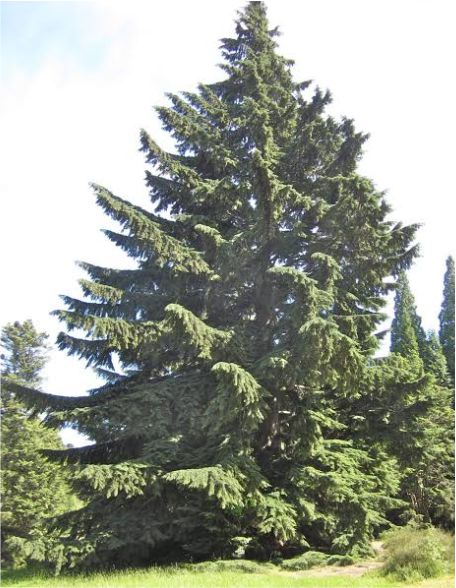
The Douglas fir can grow to be very tall indeed, reaching up to 60 metres in Britain. It has soft needles with two grey bands underneath and oval shaped cones that hang downwards. Its bark is reddish-brown, fissured and corky.

A thin and narrow-crowned tree which grows to 40-50 metres. It has twisted yellowish-green needles found in pairs that measure 5–8 cm long and cones with prickly scales. The bark is variable but typically red-brown with fine curled flakes.

A conically shaped tree reaching up to 40 metres in height. It has long cylindrical brown cones which hang down and pointed mid-green needles standing on tiny pages. The smooth bark is greyish-brown with a rusty tint.

The fifth largest conifer, it tends to grow up to 55 metres but can reach 100 metres. Flattened solitary needles and light brown, papery cones hang on drooping branches. The bark is greyishbrown when mature and flakes off in round scales.

The hybrid larch can grow to 40 metres in height. It grows deciduous needles in rosettes on short shoots and reddish purple flowers which form cylindrical cones with rounded scales. Its grey-brown bark is fissured into regular plates.

A handsome conifer which can reach 45 metres in height. It has long upswept bluish-grey needles and large upright cones with downturned feathery bracts. The smooth bark is pale grey to purplish.

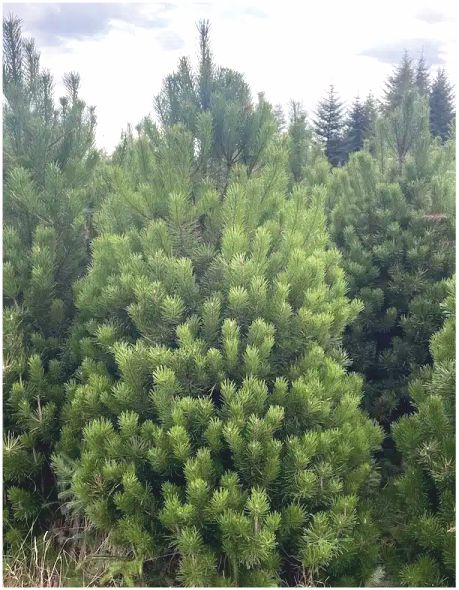
Scotland's national tre. It matures to up to 36 metres, and tends to lose its lower branches as it ages. It has brown, egg-shaped cones, in clusters of two to four with a small sharp prickle on each scale. Its twisted blue-green needles are found in pairs. The upper bark is an orange-red, while the lower bark is deeply fissured.

This tree has random needles of varying lengths, with green above and white below. Its characteristic drooping and small egg-shaped cones. As it ages, the tree loses its lower branches and its bark becomes deeply furrowed into scaly ridges.

This tree usually resembles a shrub, but can reach seven metres if left uncut. In October ripe nuts enclosed in leafy bracts appear, whilst in late winter, male flowers form ‘lambs-tail’ catkins. The bark is smooth, shiny brown with conspicuous yellow lenticels and scaly patches

This graceful, narrow tree is easy to spot in autumn due to its bright red berries. It has flat heads of cream coloured, heavily scented flowers and smooth, purplish or grey-brown bark.

The small-leaved lime has downward arching branches and grows to 35 metres tall. It has sweet smelling flowers which attract bees, other insects and birds including woodpeckers. Its smooth, grey bark cracks with age.

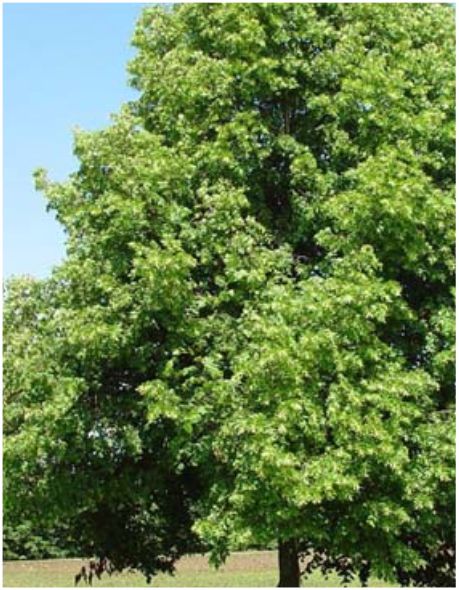
This is a broad tree with dense foliage reaching 25 metres. It can be recognised by its winged seeds, set in pairs, that fall like helicopter blades. Its leaves o‘tar spots’ caused by the fungus Rhytisma acerinum.

Yew

A round, densely-branched tree that grows from 15 to 29 metres tall. The light brown bark is thin and scaly, becoming deeply furrowed and breaks away in long flakes. Every part of the tree -except the fleshy seed cap - is poisonous to man and cattle not to deer or rabbits.

Ash

These tall, domed trees can reach up to 40 metres in height. The leaves are arranged in pairs whilst the single-winged seeds grow in bunches. The bark starts smooth and greenish-grey before turning grey and fissured with age.

Oak

This broad spreading tree can reach up to 30 metres in Scotland. Most do not produce acorns until they are over 50 years old. The oak’s acorns are carried on long stalks or ‘peduncles’.

This tree can grow to 24 metres, with spreading lower branches and the rest pointing up. It has triangular leaves and papery, peeling upper bark.

Broadening with age, this tree can reach up to 40 metres in height. It grows long catkins, the remains of which stay attached to the husk until they fall off. Its bark can be recognised from its long diagonal fissures.

This tree's scented white flowers are followed by small green cherries, which turn red then purple when ripe. Birds quickly strip the fruit and spread the seeds by dropping or swallowing them. The wild cherry has smooth purplish-brown bark.

Mature beech trees have a dense canopy made up of many branches. Its husks split to release two triangular seeds which can be eaten or roasted to make a type of coffee. The bark is smooth, grey and delicate – making it a popular tree for lovers to carve their initials into.